

Oil-Free Air Compressors
There’s a difference between oil removal and no oil – it matters for your application!
Oil-injected compressors with downstream filtration can achieve very low oil carryover, but they cannot guarantee zero contamination without additional treatment equipment. Oil-free air compressors options are specifically designed to have no oil in the compression stage at all, so there’s no internal oil to carry over. For applications where even a trace of contamination is unacceptable – food production, pharmaceuticals, medical – that distinction is the whole point.
J&J Air Systems supply oil-free compressors (also called oilless air compressors) from leading manufacturers across a range of flow rates, pressures and technologies. We’ll tell you honestly whether your application genuinely needs oil-free compression, or whether filtration is an appropriate and more cost-effective alternative. Browse the full range in our oil-free air compressor shop.
Discuss your requirements with us →
Why choose oil-free compression
When do you actually need oil-free?
Not every application requires oil-free compression, and specifying it where it isn’t needed adds unnecessary cost. But for the following applications, oil-free is either a regulatory requirement or the only reliable way to manage contamination risk:
- Food and beverage production where air contacts product or primary packaging
- Pharmaceutical manufacturing — any process air or packaging contact
- Medical and dental compressed air supplies
- Electronics manufacturing and precision assembly
- PET bottle blowing
- Cleanroom environments
- Any process requiring ISO 8573-1 Class 0 certification
If you’re unsure whether your application requires oil-free compression or whether high-quality filtration would meet your specification, contact us and we’ll give you a straight answer.
Oil-free compressor technologies
Oil-free rotary screw
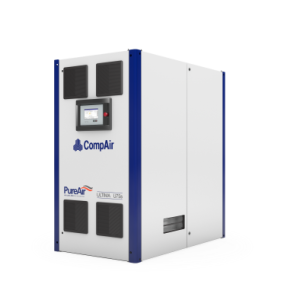
The CompAir D Series and Ultima range are high-performance oil-free compressors for continuous-duty industrial applications where air quality, energy efficiency and long-term reliability are critical. Both ranges are certified ISO 8573-1 Class 0 and are available in fixed speed and variable speed drive (VSD) configurations.
The Ultima features advanced high-efficiency motor technology and intelligent control systems that significantly reduce operating costs compared to conventional oil-free technology. Compact footprints, low noise levels and simplified maintenance access minimise downtime.
Both ranges are frequently specified as alternatives to Atlas Copco ZR and ZT oil-free compressors, particularly where lower lifecycle costs and independent service support are a priority.
Oil-free scroll and piston
The CompAir S Series scroll compressors are well-suited to lower flow rate applications requiring quiet, oil-free air – laboratories, cleanrooms, and light industrial processes. Scroll technology is inherently smooth and low-vibration, with fewer moving parts than screw or piston designs.
Bambi oil-free piston compressors are the standard choice for dental surgeries, medical facilities and small laboratories. Built in the UK, the Bambi VT range uses tilting piston technology to achieve some of the lowest noise levels of any oil-free compressor in its class, making it well suited to clinical and office-adjacent environments where noise is a practical concern. Duplex units are available allowing higher-output configurations to run from a standard single-phase supply without costly electrical upgrades. HTM02-01 compliant options are available for both NHS and private dental practices

ISO 8573-1 Class 0 – what it means?
ISO 8573-1 is the international standard that defines compressed air purity classes for solid particulates, water and oil content. Class 0 sits above Class 1 as the most stringent designation, it means oil content is held to a level more stringent than any defined class, as agreed between the equipment user and supplier.
Atmospheric air already contains traces of oil vapour from vehicle exhausts and industrial processes. An oil-free compressor drawing in atmospheric air does not eliminate this background contamination, which is why additional filtration is often specified even on oil-free systems for the most critical applications. We’ll advise on the full system specification needed to achieve and document the purity class your application requires.
ISO 8573-1 compressed air purity classes
The table below summarises the key purity classes under ISO 8573-1:2010. Each class defines acceptable limits for three contaminant groups — solid particulates, water and oil. Most regulated industries in the UK specify Class 0, 1 or 2 for process air.
| ISO Class | Particles >1µm (per m³) | Water (Pressure Dewpoint) | Total Oil (mg/m³) | Typical application |
|---|---|---|---|---|
| Class 0 | As specified – more stringent than Class 1 | As specified – more stringent than Class 1 | As specified – more stringent than Class 1 | Sterile pharmaceutical manufacturing, critical cleanrooms |
| Class 1 | ≤ 10 | ≤ −70°C | ≤ 0.01 | Sensitive electronics, optics, semiconductor |
| Class 2 | ≤ 100 | ≤ −40°C | ≤ 0.1 | Food contact, pharmaceutical packaging, painting |
| Class 3 | ≤ 1,000 | ≤ −20°C | ≤ 1 | General food & beverage, chemical processing |
| Class 4 | ≤ 10,000 | ≤ +3°C | ≤ 5 | Pneumatic tools, general manufacturing |
| Class 5 | ≤ 100,000 | ≤ +7°C | — | Outdoor use, construction, non-critical processes |
| Class X | > 100,000 | > +7°C | > 5 | Unclassified / unconditioned air |
Particle counts refer to the 1–5µm size range. The full ISO 8573-1:2010 standard also defines classes for 0.1–0.5µm and 0.5–1µm particle ranges and liquid water content. Contact us if you need to establish the exact purity class required for your process.
Industry applications
Food and beverage
Oil contamination in food production can cause product spoilage, batch write-offs and serious food safety incidents. BRC Global Standards and retailer codes of practice increasingly require documented evidence of oil-free compressed air where air contacts product or primary packaging. Oil-free compressors remove the risk at source and simplify audit compliance.
Pharmaceutical and life sciences
GMP requirements for pharmaceutical manufacturing treat compressed air as a critical utility. Process air, packaging line air and any air contacting product or equipment must be demonstrably free of contamination. ISO 8573-1 Class 0 certification and documented air quality testing are standard requirements for pharmaceutical validation.
Medical and dental
Dental and medical compressed air must meet HTM02-01 (Health Technical Memorandum) requirements in the UK. Bambi oil-free piston compressors are designed specifically for this application, with duplex configurations available for duty/standby operation and validated performance for NHS and private practice environments.
Electronics and precision assembly
Oil contamination in electronics manufacturing causes component failures, soldering defects and yield losses that are difficult to trace. Oil-free compressed air is standard practice in PCB assembly, semiconductor handling and precision instrument manufacture.
Chemical processing
Oil contamination can compromise chemical reactions, degrade catalysts and create safety hazards in flammable or reactive environments. Oil-free compression removes an unpredictable variable from process air and simplifies hazardous area compliance.
Automotive finishing
Paint and lacquer application requires completely oil-free air to prevent fisheye defects and surface contamination. Oil-free compressors are increasingly specified in bodyshops seeking to eliminate the risk of oil carry-over from upstream equipment rather than rely solely on point-of-use filtration.
Filtration as an alternative
Oil-free air can also be achieved from oil-injected compressors with the right downstream filtration and treatment, activated carbon filters, activated carbon towers or catalytic conversion systems can all deliver very low oil content in delivered air. This approach carries a lower capital cost and may be appropriate where Class 0 certification is not a hard requirement.
We’ll tell you honestly which approach is right for your application and budget. If filtration will do the job, we’ll say so.
Talk to us about your application
We supply and service oil-free compressors across London, the Home Counties and surrounding areas. Whether you need a single dental compressor or a multi-machine Class 0 installation for pharmaceutical production, we’ll specify the right equipment and handle the full project from survey through to commissioning and ongoing maintenance.
Call: 0800 027 8442 | Email: [email protected]